
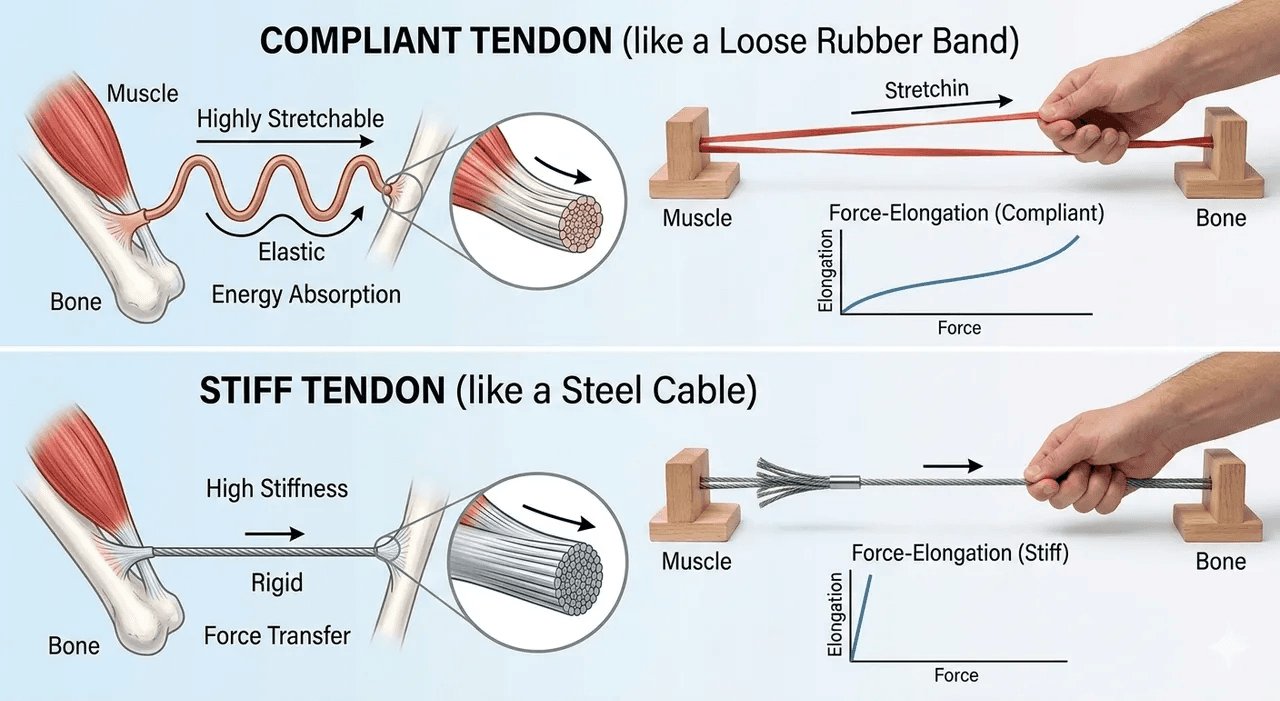
In sport we are obsessed with muscular hypertrophy, neurological adaptations, or our athletes’ ability to metabolically clear byproducts of exercise faster, such as lactate. We obsess over an athlete’s muscle while the primary biological gateway for translating force production into the ground is a specialized, trainable architecture known as the muscle-tendon unit. The tendinous attachments to a muscle belly dictate whether the athlete becomes an explosive catapult or an overstressed mattress that wastes force.
This deep analysis explores the basic biomechanics of force transfer and gives the general reader an opportunity to understand this not-so-well-known feature of strength and performance (Bohm, Mersmann, & Arampatzis, 2015).
1. The Compliant Tendon (The Loose Rubber Band)
Compliant, flexible tendons possess relatively high adaptability. Instead of offering rigid resistance to load, they temporarily grant elastic slack—the musculotendinous equivalent of a loose rubber band. They excel at absorption, providing a safety buffer against sudden impacts and high eccentric forces. For joints, they can protect during unpredictable movements, especially when moving in and out of a pattern.
However, compliant tendons also have disadvantages. While they provide elasticity and cushioning, they do not convey information to the joint immediately or with maximum urgency. There is a latency before force transfer is complete; muscle contraction, kinetic energy, and intention are damped (Baar, 2019).
2. The Stiff Tendon (The Steel Cable)
Not all tendons are designed for flexibility. Tendons with higher stiffness and increased force requirements possess dense, collagen-packed matrices. Upon muscular contraction, stored energy is translated to the skeletal levers immediately. This allows athletes to display elite ballistic power, instantaneous reactivity, and lightning-sharp changes of direction where every hundredth of a second is in play.
How does an athlete transform tendons from soft, pliable rubber into high-velocity cable? Conventional lifting will not always suffice. High-velocity or cyclic training relies heavily on elastic capacity and can create micro-disruptions rather than wholesale tissue remodeling. Isometric strength training, however, keeps muscle fibers locked under prolonged mechanical burden. This triggers tendon fibroblasts, increasing collagen synthesis, reorganizing fiber cross-links, and stiffening the extracellular matrix (Bohm et al., 2015).
The Period of Degradation: Use It or Lose It
Tendon stiffening is a temporary adaptation. Just as the body builds tendons into rigid, high-velocity springs in response to high mechanical burden, it can rapidly deconstruct that stiffness within several weeks.
- 24 to 48 hours—acute viscoelastic fatigue: Following exhaustive block plyometrics, high-volume depth-jump eccentrics, or long-distance cyclic running, acute structural softening can occur. Reduced stiffness may take up to two days to resolve (Kubo et al., 2012).
- 2 to 3 weeks—chronic tissue softening: When the stimulus is removed completely or training centers only on low-load recovery, natural elasticity can redevelop in under three weeks (Baar, 2019).
Detouring the Decay—the Isometric ‘Shield’
Peak season demands prolonged, high-intensity exertion. Athletes can avoid overtraining and minimize joint inflammation and tissue tears common in demanding stretch-shortening cycles by adding heavy isometric exercises to their strength routines. Isometrics keep mechanical tension high without the same damage. Complete force expression against static loads significantly reduces or eliminates cellular microtrauma, preserving the athlete’s muscular ‘steel cables’ for rapid energy transfer and subsequent performance cycles.
References
- Baar, K. (2019). Stress relaxation and targeted training to reduce tendon injury. International Journal of Sport Nutrition and Exercise Metabolism, 29(4), 453–457.
- Bohm, S., Mersmann, F., & Arampatzis, A. (2015). Human tendon adaptation in response to mechanical loading: a systematic review and meta-analysis of exercise interventions. Sports Medicine, 45(11), 1627–1642.
- Kubo, K., Ikebukuro, T., Yata, H., Tsunoda, N., & Kanehisa, H. (2012). Time course of changes in muscle and tendon properties during strength training and detraining. Journal of Strength and Conditioning Research, 26(2), 505–513.
Biography
Gary Augustine Warren, BS, CSCS, LMT
Since earning a Bachelor's degree in Health and Sports Sciences from the University of Oklahoma in 1997, Gary has built an illustrious near 30-year career as a Certified Strength and Conditioning Specialist (CSCS) and personal trainer through the National Strength and Conditioning Association (NSCA). As an Oklahoma-licensed massage therapist (LMT), he has honed a holistic approach to fitness and recovery. He has served as a staff member or performed contract work at prestigious institutions like UCLA, Long Beach State, and the University of Oklahoma. Gary's expertise extends beyond academia, with impactful roles in two sports entertainment organizations and the private sector. His innovative training methods and dedication to client success have consistently elevated athletic performance and well-being over decades of professional practice.